AI Origins
From the Nile
to the Neural Network.
Egyptian Mathematical Traditions and Their Foundational Role in Modern Generative AI.
Four mathematical threads, traced across 3,400 years, from the Rhind Papyrus to the
transformer architecture.
Concept by Eamon Moore FCCA MSc Accountancy, NTRRPA/AI
Research by Claude™ (Anthropic™) · March 2026
The Central Question
Did Ancient Egypt Plant the Mathematical Seeds of Generative AI?
The Algebra
Did the symbolic algebra of Diophantus and Abu Kamil give rise to the embedding
vectors that power large language models?
The Geometry
Did Hypatia's angular geometry and Eratosthenes' spatial calculations become the
cosine similarity that drives vector search?
The Algorithm
Did Eratosthenes' Sieve and Ahmes' fraction decomposition evolve into the ANN search
and semantic chunking of modern RAG pipelines?
The conceptual lineage is unbroken across four mathematical threads and 3,400 years.
Not a claim of direct causation — a claim that the ideas modern AI depends on were
first posed, and first solved, in the ancient Mediterranean world.
The Ancestral Mathematicians
Seven Scholars Whose Work Flows, Unbroken, Into Every Modern AI System
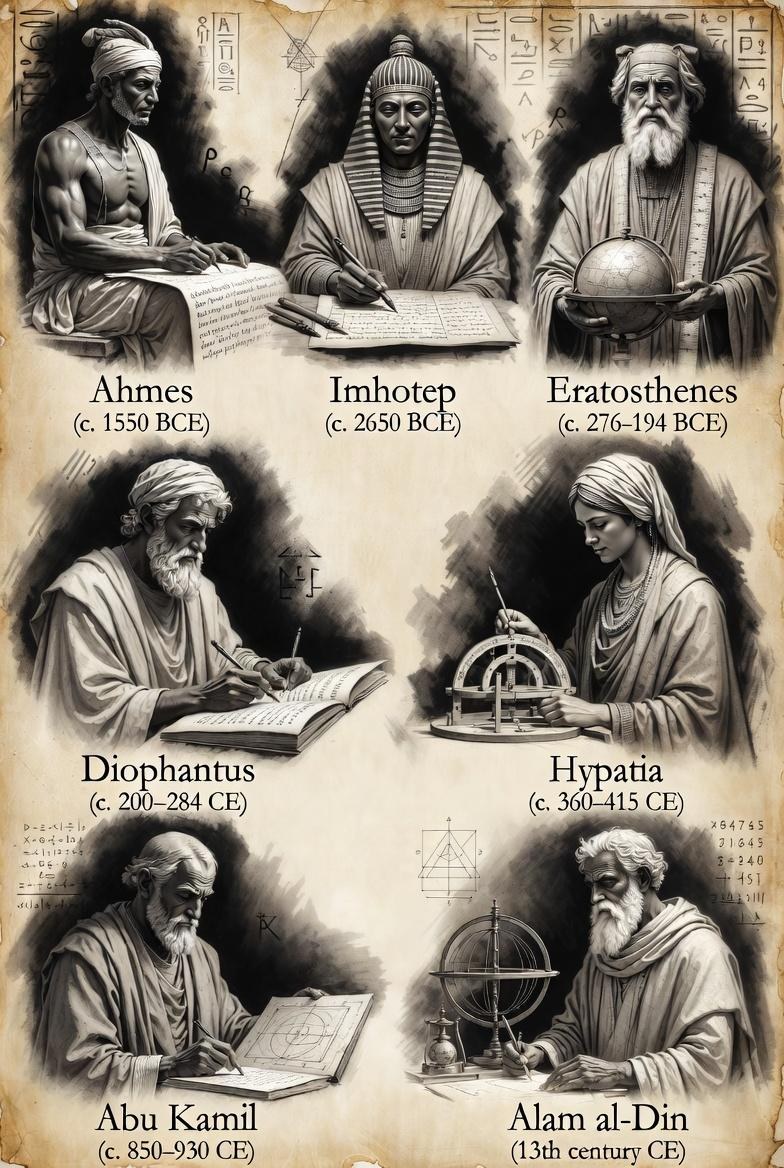
Artistic renderings. No contemporary likeness survives for any of these figures.
Imhotep c. 2650 BCE
Surveying geometry → L1 / L2 distance
Ahmes c. 1550 BCE
Unit fractions → Tokenisation & chunking
Eratosthenes 276–194 BCE
Sieve algorithm → ANN search (HNSW / FAISS)
Diophantus 200–284 CE
Symbolic algebra → Latent embedding space
Hypatia 360–415 CE
Conic sections & angles → Cosine similarity
Abu Kamil 850–930 CE
Algebraic geometry → Vector space foundations
Alam al-Din 13th c. CE
Celestial coordinates → High-dimensional embeddings
Thread One
Algebraic Symbolism → Embeddings & Latent Space
Ahmes
c. 1550 BCE
Unit fractions: any quantity encoded as structured numerical units
Diophantus
c. 250 CE
Symbolic unknowns: variables as manipulable mathematical objects
Al-Khwarizmi
c. 820 CE
Al-jabr: procedural algebra — the first algorithms
Abu Kamil
c. 880 CE
Algebraic geometry: unknowns inhabit structured spatial positions
Transformer
2017 CE
Matrix algebra produces float arrays encoding semantic meaning
Key Finding
An embedding, as Databricks™ documentation describes it, is an array of floating-point
values that carries semantic meaning. That is Ahmes' unit-fraction principle — encoding a
complex whole as structured numerical components — expressed in Diophantus' symbolic
framework, at the scale Al-Khwarizmi's procedural algebra made possible.
Thread Two
Spatial Geometry → Distance & Similarity Metrics
Imhotep · c. 2650 BCE
Euclidean Distance (L2)
Modern Use
Straight-line distance between vectors. Used for clustering and anomaly detection.
Ancient Ancestor
Pyramid survey geometry: rectilinear distance across the Saqqara plateau.
Hypatia · c. 390 CE
Cosine Similarity
Modern Use
Angle between vectors. Databricks™ documentation notes that it weighs orientation — semantic meaning — rather than magnitude.
Ancient Ancestor
Conic section theory: the angle between two curves defines their relationship, not their distance.
Eratosthenes · c. 240 BCE
Manhattan Distance (L1)
Modern Use
Sum of absolute differences. Grid-based similarity for sparse data.
Ancient Ancestor
Earth circumference via angular shadow measurement — axis-by-axis spatial reasoning.
Thread Three
Numerical Algorithms → ANN Search & Semantic Chunking
Eratosthenes' Sieve → HNSW & FAISS
The Sieve (c. 240 BCE): Enumerate all candidate primes.
Apply a test. Eliminate failures. Retain survivors. Repeat at finer granularity.
HNSW / FAISS (2018–2019): Enumerate candidate vectors
in a hierarchical graph. Apply a distance test. Eliminate non-neighbours. Retain survivors.
Descend to the finer layer.
Approximate nearest-neighbour search examines only a fraction of the index and still returns
highly relevant results — Eratosthenes' principle, executed in floating-point space at
billion-vector scale.
Ahmes' Fractions → Semantic Chunking
Rhind Papyrus (c. 1550 BCE): Any rational quantity is
the sum of distinct unit fractions. Each component is independently meaningful. Together they
recover the original whole.
Semantic Chunking (2020s): Any document is a sequence
of semantically coherent segments. Each chunk is independently embeddable and retrievable.
Together they span the original content.
Chunking strategies split text at meaningful linguistic boundaries so each segment keeps its
semantic integrity — Ahmes' decomposition principle, applied to language.
Thread Four
Astronomical Coordinate Systems → High-Dimensional Embedding Spaces
Alam al-Din's Celestial Globe
| System | Surface of a sphere |
| Coordinates | Right ascension + declination |
| Object Encoding | Every star → 2 scalar values |
| Distance Metric | Spherical law of cosines |
| Multi-Resolution | Constellation → star: coarse-to-fine |
| Query Method | Angular separation from target point |
Modern Embedding Space
| System | n-dimensional float space |
| Coordinates | n learned axis values |
| Object Encoding | Every token → n scalar values |
| Distance Metric | Cosine similarity (flat-space limit) |
| Multi-Resolution | HNSW: top layer → fine layer |
| Query Method | Angular distance from query vector |
The celestial globe and the vector index are the same mathematical object: a metric coordinate
space where complex entities are encoded as numerical points and retrieved by spatial proximity.
The First RAG System
The Library of Alexandria ≡ Retrieval-Augmented Generation
1 — Retrieval
Library of Alexandria (c. 295 BCE): A scholar poses a question. Librarians search the indexed scroll collection for relevant material.
Modern RAG: The system searches an indexed knowledge base for the data chunks most relevant to the query.
2 — Augmentation
Library of Alexandria: Relevant scrolls are retrieved and placed before the scholar — injected into their reasoning environment as context.
Modern RAG: Those retrieved chunks are inserted directly into the model's context window.
3 — Generation
Library of Alexandria: The scholar synthesises a response — a commentary, a proof — grounded in retrieved material, not unaided internal memory.
Modern RAG: The model composes its answer from the injected material rather than from parametric memory alone.
Same architectural pattern. Same epistemological problem. 2,320 years apart.
The Transmission Route
How the Alexandrian Corpus Reached the Modern AI Mathematical Substrate
c. 295 BCE
Library of Alexandria Origin node. Geometry, algebra, sieve algorithms.
c. 820 CE
House of Wisdom, Baghdad Translation & extension. Al-Khwarizmi, Abu Kamil, Ibn al-Haytham.
c. 1125 CE
Toledo School of Translators Arabic → Latin. Almagest, Euclid, al-jabr enter Europe.
c. 1202 CE
Fibonacci & Europe Liber Abaci: Hindu-Arabic numerals, algebraic procedures.
c. 1858 CE
Cayley & Linear Algebra Matrix notation. Vector spaces (Peano, 1888).
2017 CE
Transformer Architecture Vaswani et al. Embeddings, attention, RAG pipelines.
The Three-Institution Model
Library of Alexandria (c. 295 BCE)
Origin: geometry, algebra, sieve algorithms
House of Wisdom, Baghdad (c. 830 CE)
Bridge: systematisation, optics, spherical trigonometry
Modern AI Lakehouse (2020s)
Realisation: Delta Lake, vector indexes, LLM inference
The Complete Lineage
Four Mathematical Threads · 3,400 Years · One Unbroken Chain
1
Algebraic Symbolism
Ahmes → Diophantus → Al-Khwarizmi → Abu Kamil → Fibonacci → Cayley
→ Embedding models · Latent vector spaces · Transformer attention
2
Spatial Geometry
Imhotep → Eratosthenes → Hypatia → Islamic trigonometry → Analytic geometry
→ L1 / L2 / Cosine similarity · Vector distance metrics · Semantic retrieval
3
Numerical Algorithms
Ahmes' fractions → Eratosthenes' Sieve → Al-Farabi's hierarchies → ANN theory
→ HNSW · FAISS · Semantic chunking · Document decomposition
4
Astronomical Coordinates
Ptolemy's Almagest → Astrolabe projection → Alam al-Din's globes → HNSW layers
→ High-dimensional embedding spaces · Multi-resolution vector indexing
“Every matrix multiplication we perform, every attention head, every gradient
descent step — all of it ultimately flows from that same ancient river of human
curiosity.”
The well is deep.
Discuss This With Us →
Credits
Concept: Eamon Moore FCCA MSc Accountancy, NTRRPA/AI
Research: Claude™ (Anthropic™)
Portraiture: Grok (xAI)
March 2026
|
|
|